



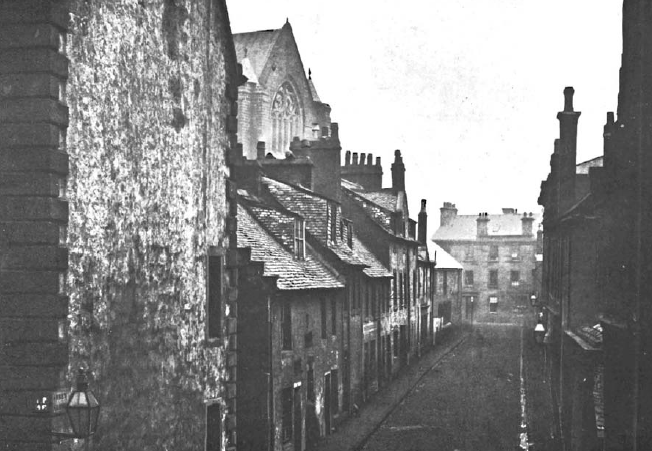
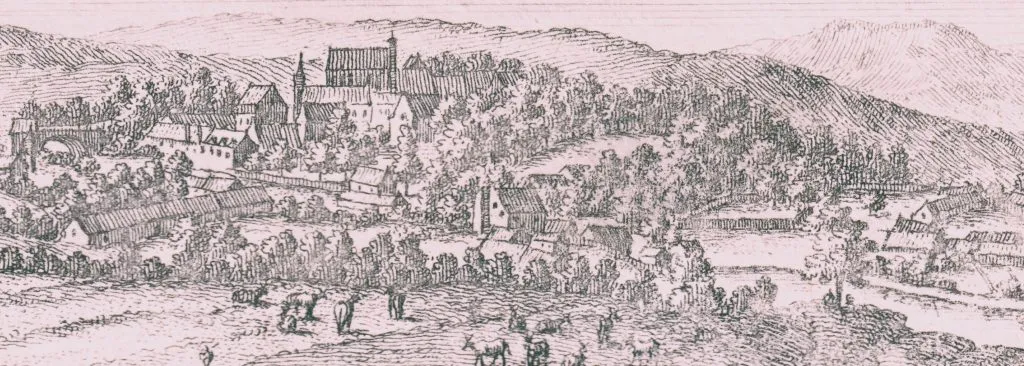
Let us recall the beautiful situation and surroundings of the abbey in the palmy days of the Abbots. The river Cart then ran clear and sparkling between green wooded banks. The monastic buildings: the great Gatehouse built by Abbot Tervas, about 9 meters north-west from the north-west turret of the Abbey, “a great pend most curiously built,” surmounted with a tower erected by Abbot George Shaw; the massive wall extending for a mile or so round the Abbey policies, adorned with statues and inscriptions; the Abbot’s house to the south-east; and some additional buildings sloping down to the river, were all in Existence. The old Cloisters were intact, the wall of the west walk being 7.3 meters from the west front of the Abbey.
Towards the end of the 15th century another wall was erected 2.7m beyond the west front of the Abbey, extending 25 meters southwards. A roof was erected on this wall and the cloister wall, and the inside fitted out for Monastic purposes. The south front of the Abbey became a gable for this building.
Close by were the pools or tanks, lined with ashlar work, in which the monks kept fish against in case fishing in the River Clyde failed to supply enough food for them.
The rich gardens of the monastery were also near, and a deer park; on the other bank of the river, beside the Falls, stood the Abbey mill, and, further down on the same side, the large orchard, extending over six acres. A columbarium or dovecot stood on the brink of the river opposite the Watergate at the Seedhill Mills.
An UNDERGROUND PASSAGE, dating from this period, still in part exists, apparently leading from the Abbey southwards towards the river white cart. It is solidly built. During an exploration of the passage in 1888, 120 carts of rubbish were taken out, amongst which several articles were found, including fragments of stained glass.
There was an OLD CHURCHYARD of the Abbey at Seedhill while the present churchyard surrounding the abbey is post reformation. The burial place of the Priors, Abbots & Monks would have been south, or to the east, of the Abbey church.
Notabilities may have been buried in the choir and under the chapter house, where remains have been found. There were interments in the cloisters, but not in the garth.
Connected with the chapel of St. Roche, there was also a churchyard at the head of Castle Street. In later times, the weavers, when digging treadle holes for their looms, often found the bones of their Roman Catholic forbears.”
The Abbey during this period was distinguished as being ONE OF THE FIVE PLACES OF PILGRIMAGE in Scotland, the others being Melrose, where the first Steward had died as a monk: Scone, where the first Stewart king was buried; Dundee; and Whithorn. Crosses for the use of pilgrims were placed at intervals on the roads leading to the church. The local names with Corsebar and Crossflat reflect possible lost cross sites along with those we know existed at Hawkead, Stanely and Arthurie to name but a few.
Text sourced and updated from A R Howell’s Paisley Abbey published 1929.